News
Stories making wavesTime to 'Shell-abrate"
GIANT TORTOISE NUMBERS RISE TO 180,000
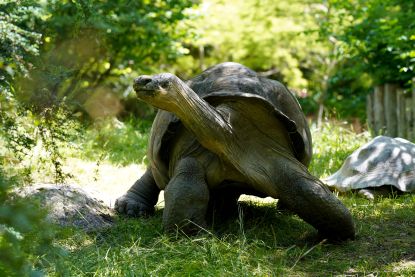
A century after the species stood on the brink of extinction, Aldabra giant tortoises have been found to be thriving again in the Seychelles! A landmark survey by the Seychelles Islands Foundation (SIF) and the University of Exeter and recently published in the scientific journal Ecology and Evolution, found over 180,000, the highest figure ever recorded for the free-roaming species, on the Aldabra Atoll, one of Seychelles remote islands, in the Indian ocean.
Aldabra giant tortoises (Aldabrachelys gigantea) have great importance as ecosystem engineers and have very long necks which enable them to nibble tree branches up to a metre from the ground. They may also fell trees in their search for food and create pathways used by other animals. Accurate monitoring is vital in understanding both the size and dynamics of their populations, and their influence on the wider ecosystem.
Proving the maxim that 'slow and steady wins the race', their new population figure was obtained by a team who analysed five years of tortoise counts between 2018 and 2022 and it's the first update since a widely cited figure of 100,000 tortoises from the late 1990s. One of the co-authors, Dr Nancy Bunbury said, "Aldabra's giant tortoise monitoring programme is one of the longest running in the region, but the atoll's dense vegetation makes counting tortoises genuinely difficult in places. By modelling what we didn't see, as well as what we did, we've produced the most reliable baseline yet for this iconic Seychelles species, establishing a benchmark we can use to track the population for decades to come."
Historically fossils indicate that giant tortoises once occurred on every continent and many islands around the world. The Aldabra Atoll which became a nature reserve in 1981 and a Unesco site in 1982, has been dubbed one of the greatest conservation success stories of the Indian Ocean. The study found that tortoises occur at highest densities in Aldabra's grasslands, or 'tortoise turf', followed by open exposed surfaces and open mixed scrub. Tortoises were harder to detect in dense scrub, mangrove and Pemphis habitats.
"More than 180,000 giant tortoises roaming freely on our atoll is proof of what long-term commitment to conservation can achieve," said Dr Frauke Fleischer-Dogley, CEO of the Seychelles Islands Foundation. "This is wonderful news for Seychelles, for the world, and for everyone who has worked to protect Aldabra."
The researchers and project managers have said that continued vigilance will be needed to guard against threats of predators and climate change, the latter leading to longer and more frequent droughts which are likely to reduce both their shade and food, whilst rising sea levels threaten low-lying parts of the island. So, whilst this latest success story is great news for this once endangered species the University of Exeter's Dr Dave Hudson, said:
"These results are great news for the tortoises and testament to the fantastic work done in the field - but it's important to remember that the numbers provide a baseline, not an endpoint. Hopefully, we have provided the conservation managers the evidence they need to track future change and act early as the tortoises face increasing pressures from climate change, drought and invasive species."
(Pic credit: Image above left by Markus Kammermann)